 ultimate-guide
How to Choose High Quality Supplements: 2026 Guide
Table of Contents
- Why Supplement Quality Varies More Than You Think
- The FDA Regulation of Dietary Supplements: What It Does and Doesn't Cover
- Your Supplement Label Reading Guide: From Serving Size to Active Ingredients
- Why Third-Party Supplement Testing Matters More Than Any Seal
- 7 Clear Signs of a Low-Quality Supplement Brand
- How to Choose High Quality Supplements: A Step-by-Step Checklist
- The Hidden Cost of Cheap Supplements: Value vs. Price
- Your Next Steps for Choosing High Quality Supplements
- Frequently Asked Questions
Last Updated: September 9, 2026
Why Supplement Quality Varies More Than You Think
The challenge of how to choose high quality supplements starts with a surprising truth: two bottles with identical names can contain wildly different ingredients. The difference between a product that supports your health and one that wastes your money often comes down to factors invisible on the front of the label. This guide breaks down what separates dependable high quality supplements from the rest of the shelf.
Dietary supplements are products intended to supplement the diet with vitamins, minerals, herbs, amino acids, or other substances. The market is crowded, and quality varies dramatically between brands. Most consumers assume regulation guarantees safety and accuracy, but that assumption deserves closer scrutiny. Below, we'll show you exactly how to evaluate products with confidence, from reading labels to verifying third-party testing.
The FDA Regulation of Dietary Supplements: What It Does and Doesn't Cover
FDA regulation of dietary supplements differs fundamentally from prescription drugs. Under the Dietary Supplement Health and Education Act of 1994, manufacturers are responsible for ensuring their products are safe before they go to market. The FDA does not approve dietary supplements for safety or effectiveness before they are sold.
This means the burden of quality control falls on the manufacturer, not the regulator. The FDA's guidance on dietary supplements makes clear that while the agency can take action against unsafe products after they reach shelves, it lacks the pre-market authority it holds over pharmaceuticals. Products can be marketed without proving they work, and in many cases, without proving they contain what the label claims.
In practice, this creates a wide quality gap. Some manufacturers follow rigorous standards voluntarily. Others cut corners on ingredient sourcing, potency, and purity. The label alone cannot tell you which category a product falls into, which is why independent verification matters so much.
Your Supplement Label Reading Guide: From Serving Size to Active Ingredients
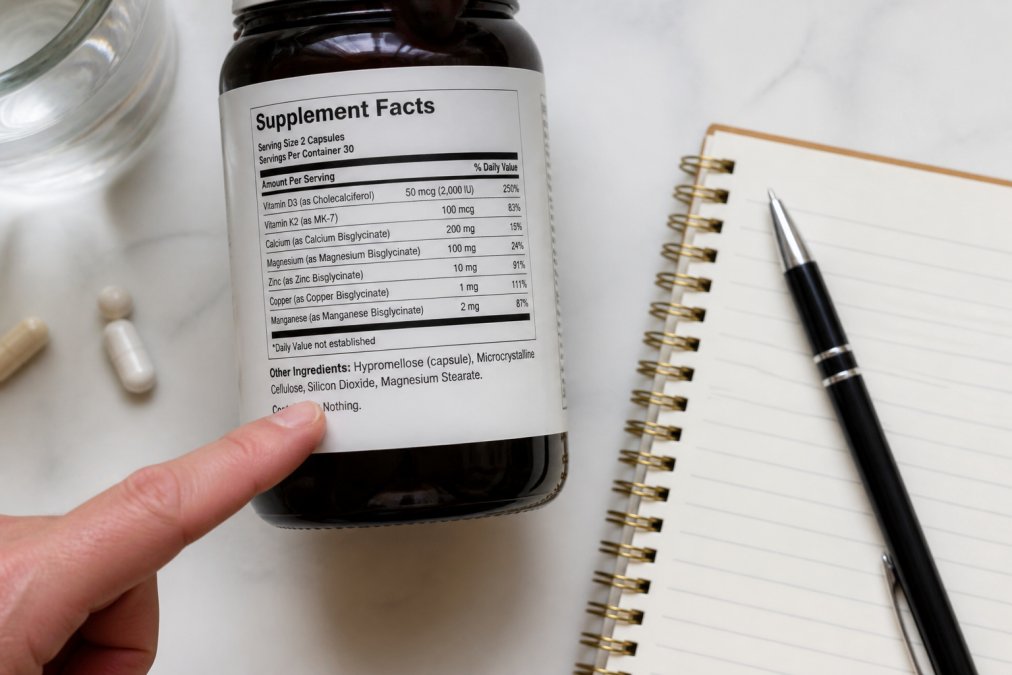
A supplement label reading guide starts with the Supplement Facts panel, the standardized box found on every compliant product. This panel is your primary source of truth, but only if you know how to interrogate it. Here is the breakdown of what each line actually tells you, and what it hides.
Serving Size and Servings Per Container: Confirm the serving size matches how you plan to take the product. A bottle may list 60 capsules but only 30 servings if the recommended dose is two capsules. Always calculate the total cost per serving, not per bottle, to compare products fairly.
Active Ingredients and Amounts: This is where quality separates from marketing. Look for two things: the specific form of the nutrient and the amount per serving. For example, magnesium oxide is cheap but poorly absorbed, while magnesium glycinate or citrate are more bioavailable. Similarly, folic acid is a synthetic form, whereas methylfolate (5-MTHF) is the active form your body can use directly. If a label lists only "magnesium" without a form, that is a red flag for cost-cutting.
The 'Label Dosing' Trap: Many products contain ingredients in amounts too small to have any measurable clinical effect. This practice, sometimes called "label dosing," pads the ingredient list with trace amounts of trendy compounds to justify a higher price. For example, a product might list 10 mg of a botanical extract when clinical trials used 300 mg. Cross-reference the dosage against established clinical evidence for that ingredient. If the amount is a fraction of what studies used, you are paying for a label, not a result.
Standardized Extracts: Look for the term "standardized extract" on herbal ingredients. This guarantees a consistent level of active compounds from batch to batch. Without standardization, the potency of a botanical can vary wildly depending on harvest conditions and processing. A label that simply says "ashwagandha root" without a percentage of withanolides (e.g., "standardized to 5% withanolides") offers no assurance of consistency.
The 'Other Ingredients' Section: This reveals fillers, binders, and additives. Minimal, recognizable ingredients generally indicate more careful formulation. Watch for magnesium stearate, silicon dioxide, and titanium dioxide, common flow agents and colorants that serve no nutritional purpose. While not inherently harmful, their presence in large quantities can indicate a focus on manufacturing convenience over purity. If you cannot pronounce half the list, that is a reasonable cause for skepticism.
Expiration Date and Lot Number: These are not optional. The expiration date tells you when potency begins to degrade. The lot number allows traceability if a recall occurs. A product without either is a sign of poor manufacturing controls. Also check for storage instructions, some supplements, particularly probiotics and certain oils, require refrigeration to maintain potency.
By reading the label with these specifics in mind, you move from passive acceptance to active verification. The label is not just a list, it is a contract. The question is whether the manufacturer is honoring it.
Why Third-Party Supplement Testing Matters More Than Any Seal
Third-party supplement testing is the single most reliable indicator of quality available to consumers. This process involves independent laboratories verifying that a product contains what its label claims, in the stated amounts, without harmful levels of contaminants. When a brand pays for this testing, it signals confidence in its manufacturing processes.
Not all third-party testing is equal, however. The most credible programs involve certification seals from organizations that audit facilities, test finished products, and conduct unannounced inspections. A seal from a recognized certifier provides meaningful assurance of quality control and label accuracy. Without such verification, you are relying entirely on the manufacturer's word.
The absence of third-party testing does not automatically mean a product is bad. Small brands may lack the budget for certification. But when you cannot verify quality independently, you accept greater risk. For consumers serious about their health, independent verification is worth seeking out.
7 Clear Signs of a Low-Quality Supplement Brand
Recognizing warning signs helps you avoid wasted money and potential health risks. Here are seven red flags that suggest a brand prioritizes profit over quality.
- Vague or proprietary blends that hide individual ingredient amounts
- No third-party testing or certification mentioned anywhere on the packaging
- Outlandish health claims promising rapid, dramatic results
- No contact information or customer support listed on the website
- Artificial colors, flavors, and unnecessary fillers in the ingredient list
- No expiration date or lot number for traceability
- Dramatically low prices compared to established brands with similar formulations
Products exhibiting several of these signs warrant caution. A brand that cannot provide basic transparency about its formulations likely has something to hide. Conversely, brands that openly share testing results and manufacturing details demonstrate accountability.
How to Choose High Quality Supplements: A Step-by-Step Checklist
The process of how to choose high quality supplements becomes manageable when broken into clear steps. Follow this checklist to evaluate any product before purchasing.
- Step 1: Identify your specific health goal and the ingredient backed by clinical evidence for that purpose
- Step 2: Check the Supplement Facts label for therapeutic doses, not just trace amounts
- Step 3: Verify third-party testing through a recognized certification program
- Step 4: Research the manufacturer's reputation and manufacturing practices
- Step 5: Confirm the expiration date and storage requirements
- Step 6: Review potential interactions with any prescription medications you take
- Step 7: Calculate cost per serving, not just the bottle price
This framework applies whether you are evaluating a multivitamin, a protein powder, or a specialty compound. The same standards of purity, potency, and transparency should govern every purchase. Brands that cannot answer basic questions about sourcing and testing do not deserve your trust or your money.
The Hidden Cost of Cheap Supplements: Value vs. Price
The cheapest supplement is rarely the most economical choice, and the true cost extends beyond your wallet. A product that contains less active ingredient than claimed, or uses poorly absorbed forms, delivers little value regardless of its price. When you factor in the cost per effective dose, premium products often prove more economical than their bargain counterparts. But there is another dimension of cost that most buying guides ignore: the environmental and ethical footprint of what you are consuming.
The Cost-to-Value Equation: Start by calculating cost per effective serving, not cost per bottle. A $30 bottle of 60 capsules taken once daily costs $0.50 per day. A $15 bottle of 30 capsules taken twice daily also costs $0.50 per day, but if the cheaper product uses a poorly absorbed nutrient form, you may need a higher dose to achieve the same effect, making it more expensive in practice. Compare the active ingredient form and dosage against clinical evidence, then divide the price by the number of servings that actually deliver a therapeutic dose.
Bioavailability as a Cost Factor: Consider bioavailability, the degree to which your body can absorb and use an ingredient. High quality supplements frequently use forms of nutrients with superior absorption profiles. For example, vitamin D3 is more bioavailable than D2, and chelated minerals (like zinc picolinate) are generally better absorbed than inorganic forms (like zinc oxide). Paying more for a bioavailable form can mean lower overall cost because more of what you take actually reaches your system. A cheap product that passes through your body unabsorbed is not a bargain, it is a donation.
The Environmental Cost of Supplement Production: The supplement industry has a significant environmental footprint that is rarely discussed. Many popular ingredients, fish oil, palm oil-derived vitamin E, and certain botanicals, are linked to overfishing, deforestation, and habitat destruction. When you choose a supplement, you are voting with your dollars for a supply chain. Look for brands that disclose their sourcing practices. For example, fish oil products certified by the Marine Stewardship Council (MSC) or Friend of the Sea indicate sustainable fisheries. Vitamin E derived from sunflower oil is a more sustainable alternative to palm oil-derived forms. Brands that source botanicals through fair-trade partnerships or regenerative agriculture practices are increasingly common, though they are not yet the norm.
Ethical Sourcing and Labor Practices: The quality of a supplement is not just about what is in the capsule, it is about how it was made. Some botanical ingredients, such as ashwagandha and turmeric, are primarily cultivated in regions with documented labor exploitation risks. Brands that invest in ethical sourcing often pay premiums to ensure fair wages and safe working conditions. While this is difficult to verify from a label alone, brands that are transparent about their supply chain partnerships, naming their farms or cooperatives, demonstrate a level of accountability that mass-market producers rarely match.
A Framework for Evaluating Total Cost:
- Step 1: Calculate cost per effective serving (price ÷ servings that deliver a clinically meaningful dose).
- Step 2: Check for sustainability certifications (MSC, Friend of the Sea, USDA Organic, Non-GMO Project) that indicate responsible sourcing.
- Step 3: Look for supply chain transparency, brands that name their sourcing partners or publish sustainability reports.
- Step 4: Consider the packaging. Glass bottles are more recyclable than plastic, and brands that use minimal, recyclable packaging reduce their environmental burden.
- Step 5: Factor in the safety dimension. Consumer safety guidance on supplement contaminants highlights the risks of products contaminated with heavy metals, pesticides, or undeclared pharmaceutical ingredients. The money saved on a cheap product is poor compensation for exposing yourself to these hazards, or for supporting a supply chain that harms the planet.
Your Next Steps for Choosing High Quality Supplements
Choosing high quality supplements requires shifting from passive trust to active verification. The brands worth your loyalty are those that welcome scrutiny, share their testing data, and formulate with clinically meaningful doses of bioavailable ingredients. They make quality easy to verify rather than difficult to confirm.
Our curated selection, from protein blends to specialty supplements like NMN, focuses on dependable formulations that fit seamlessly into daily routines. We prioritize purity, potency, and transparency, so you can trust what you are putting into your body.
Start by auditing your current supplement routine against the checklist above. Identify products that fail to meet the standards, then replace them with brands that demonstrate genuine quality. Your health deserves the same careful consideration you give to every other important investment.
Frequently Asked Questions
How do I know if a supplement is high quality?
Look for third-party testing by independent organizations like NSF International or USP. These certifications verify the product contains what the label claims and is free from harmful contaminants. Also check for a Supplement Facts label, clear dosage instructions, and a reputable manufacturer that follows current Good Manufacturing Practices (cGMPs).
What are the biggest red flags when buying dietary supplements?
Be wary of brands making unrealistic health claims, using proprietary blends that hide ingredient amounts, or lacking third-party testing. Other red flags include vague labeling, no contact information or customer service, and prices that seem far below the market average. If a product promises a cure or overnight results, treat it as a warning sign.
Do I need to consult a doctor before starting a new supplement regimen?
Yes, especially if you take prescription medications or manage a chronic condition. Certain supplements can interact with drugs like blood thinners, blood pressure medications, or antidepressants. Your doctor or pharmacist can review potential interactions and help you determine appropriate dosages based on your individual health needs.
What is the difference between FDA-regulated drugs and dietary supplements?
Drugs must receive FDA approval for safety and effectiveness before they reach the market. Dietary supplements do not require pre-market approval. The FDA regulates them under different rules, focusing on post-market monitoring and Good Manufacturing Practices. Supplement manufacturers are responsible for ensuring their products are safe and accurately labeled before selling them.
The supplement market rewards informed buyers. By understanding label reading, third-party testing, and the warning signs of low quality, you protect both your health and your budget. Verity offers a simplified approach to premium supplementation, crafted with intention to support your vitality. Explore our collection and build a routine you can depend on. Get started with Verity and experience supplements designed for real results.