 how-to
How to Simplify Your Daily Supplement Routine
Table of Contents
- Step 1: Audit What You Take and Why
- Step 2: Find the Best Time of Day to Take Vitamins
- Step 3: Learn How to Organize Your Supplement Cabinet
- Step 4: Build a Supplement Routine Checklist That Sticks
- Step 5: Use Habit Stacking to Make Your Supplement Routine Automatic
- Step 6: Simplify Travel and Budget Without Losing Consistency
- Step 7: Avoid Common Mistakes That Derail Your Supplement Routine
- Frequently Asked Questions
Last Updated: September 11, 2026
Step 1: Audit What You Take and Why
Most people who want to know how to simplify a daily supplement routine start by buying more organizers. That's backwards. The first move is subtraction, not storage, and the second move is a safety audit, which is the step nearly every guide skips.
A supplement routine is the specific set of dietary supplements a person takes on a regular schedule, along with the timing and dose for each. Before you can simplify that routine, you need to know what's actually in it. Empty every bottle onto a table and sort each item into one of three piles: keep, question, and stop.
The "question" pile matters most, and it deserves a real audit rather than a glance. Run every item through four checks:
- Duplicate ingredients. Many multivitamins, bone formulas, and energy blends overlap. Two products can each contain vitamin D, zinc, or a B-complex, and the combined dose is what you actually swallow. Add up the percentages of Daily Value across every label before you decide a product is redundant or necessary.
- Upper limits. The FDA sets tolerable upper intake levels for several nutrients, including vitamin A, vitamin D, iron, zinc, and selenium (ods.od.nih.gov). A single supplement rarely exceeds them; stacked products sometimes do. The NIH Office of Dietary Supplements fact sheets list the upper limit for each nutrient alongside its function and food sources.
- Interactions with prescriptions. Blood thinners, thyroid medication, certain antibiotics, and some antidepressants are the classic conflicts. Vitamin K can blunt warfarin. Calcium and iron can bind thyroid medication and some antibiotics if taken at the same time. St. John's wort interacts with a long list of drugs. Prescription medications belong in the "question" pile, because interactions are real and personal.
- Stimulant and sedative stacking. Caffeine pills, green tea extract, and pre-workout blends can stack on top of each other. So can melatonin, magnesium, and valerian. If two products push the same direction, one is usually enough.
The FDA's own guidance on dietary supplement labeling and safety is clear that supplements are regulated differently from drugs, which means the burden of checking interactions falls on you and your pharmacist. Bring your full list, labels, doses, and timing, to a pharmacist for a free review. It takes minutes and catches problems no app will.
Verity builds its catalog around this idea: fewer, better-chosen products instead of a drawer full of half-used bottles.
Step 2: Find the Best Time of Day to Take Vitamins
The best time of day to take vitamins depends on the nutrient, not on your schedule. Fat-soluble vitamins like A, D, E, and K absorb better with a meal containing fat. Water-soluble vitamins and most capsules are forgiving. Magnesium and sleep-focused formulas tend to work best in the evening.
Here's the practical version:
- With breakfast: fat-soluble vitamins, B-complex, multivitamins
- With lunch or dinner: anything that upsets an empty stomach
- Evening: magnesium, sleep support, NMN if you prefer a nighttime anchor
- Split doses: anything your label says to divide
Nutrient timing matters less than consistency. Many practitioners find that taking a supplement at the wrong-but-consistent time beats taking it at the "perfect" time three days a week.
Step 3: Learn How to Organize Your Supplement Cabinet
Organizing a supplement cabinet works best when you organize by time of day, not by bottle size or brand. A cabinet sorted by "morning," "evening," and "as needed" turns a daily scavenger hunt into a single reach.
Start with a weekly pill organizer and a permanent marker. Label each compartment with the day, then fill it once a week on a fixed day, say Sunday evening. That single habit replaces 20-plus decisions per week with one.
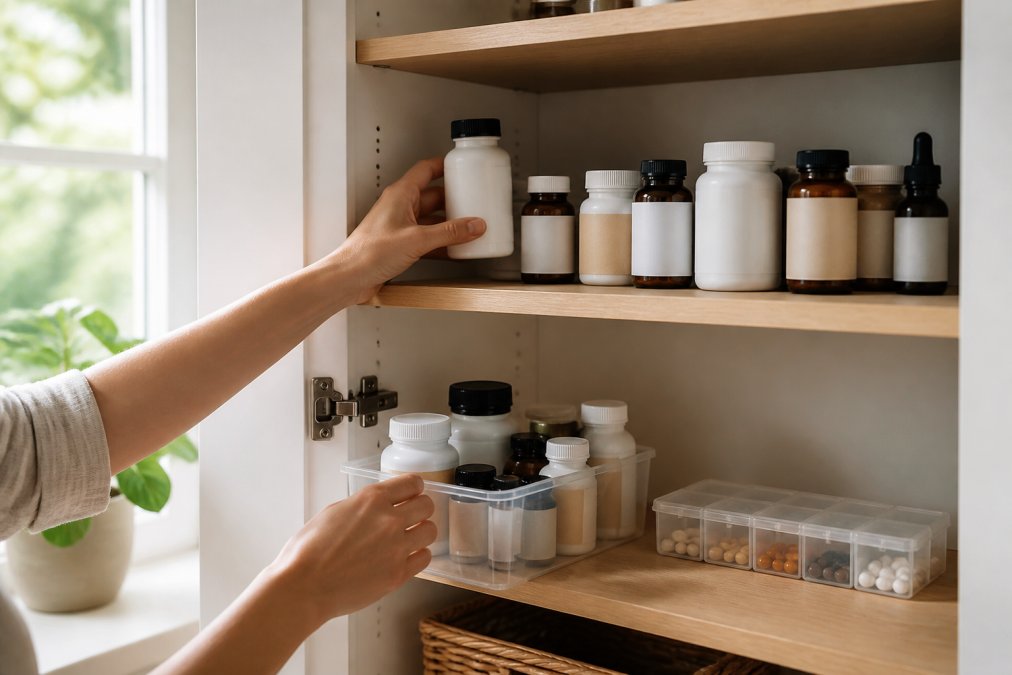
Keep the bottles themselves in a cool, dry spot away from the stove and the shower. Heat and humidity degrade many formulas faster than the expiration date suggests. A common mistake is storing everything in the bathroom medicine cabinet, the single worst place in the house for a softgel or capsule.
For anyone juggling multiple products, a daily packet system removes the sorting step entirely. Verity's simple, convenient product design is built for exactly this.
Step 4: Build a Supplement Routine Checklist That Sticks
A supplement routine checklist is a written or printed list of what you take, when, and at what dose. It works because it moves the routine out of memory and into a visual tracker you can see and check off.
Keep it to one page. Include four columns:
| Column | What to Write | Example |
|---|---|---|
| Supplement | Product name | Multivitamin |
| Dose | Amount per serving | 1 capsule |
| Time | When you take it | With breakfast |
| Check | Box to tick daily | ☐ |
The checklist does double duty. It prevents missed doses, and it gives you something concrete to bring to a doctor or pharmacist when you review interactions. Supplement compliance improves for most people the moment the routine becomes visible instead of remembered.
Step 5: Use Habit Stacking to Make Your Supplement Routine Automatic
Habit stacking is the practice of attaching a new behavior to an existing one so the established habit triggers the new one. For supplements, it's the single most effective way to prevent pill fatigue.
The formula is simple: "After I [existing habit], I will [take my supplement]."
- After I pour my morning coffee, I take my morning packet.
- After I brush my teeth at night, I take my magnesium.
- After I fill my water bottle, I take my midday dose.
Behavior change research consistently shows that anchoring to an existing cue beats relying on motivation. The cue does the remembering for you. Within two to three weeks, most people stop thinking about the routine at all, which is the goal.
Step 6: Simplify Travel and Budget Without Losing Consistency
Travel and cost are the two places supplement routines collapse. Both have simple fixes, and both reward a little planning before the trip or the purchase.
Travel: build the kit before you need it
A small zip pouch with a week's worth of doses, separated by day, fits in any bag and survives airport security without a second thought. Leave the full bottles at home. If you're flying, pack supplements in your carry-on rather than checked luggage so a delayed bag never costs you a week of consistency.
A few logistics most guides skip:
- Match the kit to the trip length. A weekender needs a four-day pouch; a two-week trip needs either two pouches or a refill plan. Pack one extra day per week as a buffer for delays.
- Keep the original label or a photo of it. TSA does not require supplements to be in original packaging, but a photo of the label answers questions fast and helps if you need to replace something abroad.
- Time zones. Shift your doses gradually rather than skipping. If you normally take magnesium at 9 p.m. and land six hours ahead, take it at your usual local bedtime for the first two nights, then move it forward an hour a night. Fat-soluble vitamins can ride with whatever meal you eat first.
- Liquid and gummy formats. Liquids over 3.4 ounces count against your carry-on liquid allowance. Gummies and capsules do not. If your routine is liquid-heavy, switch to a capsule or packet format for the trip.
- Commuting counts as travel. A small tin in a work bag handles the midday dose without a trip home.
Budget: consolidation beats coupon-chasing
A drawer of 12 bottles, each half-used, costs more per effective dose than a smaller set of products you actually finish. The budget-friendly approach is to cut anything you can't explain the purpose of, then reinvest that spend into fewer, higher-quality items.
Run the math on cost per serving, not cost per bottle. A $30 bottle with 60 servings is cheaper per dose than a $15 bottle with 20 servings. Then look for overlap: if three products each contain magnesium, one well-dosed magnesium product usually replaces all three. A single multi-nutrient formula often costs less than the sum of its single-ingredient parts, and it removes the counting step at the same time.
Verity's curated selection exists for this reason: a shorter list of dependable products beats a long list of maybes. Verified buyers like Amanda R. and Marcus T. describe the same shift, from a crowded cabinet to a routine that fits a real schedule.
Step 7: Avoid Common Mistakes That Derail Your Supplement Routine
Most supplement routines fail for predictable reasons, and every one of them is fixable.
- Buying before auditing. Adding products to a routine that's already too complex makes it worse.
- Ignoring interactions. Skipping the pharmacist review is the most common and most serious mistake.
- Storing in the bathroom. Heat and moisture degrade formulas. Move them to a cool, dry cabinet.
- Relying on memory. If it isn't written down or anchored to a habit, it will be skipped.
- Chasing perfection. Missing one dose is fine. Quitting because you missed one is not.
- Skipping the foundation. No supplement replaces sleep, baseline nutrition, hydration, and movement. Supplements support a healthy routine; they don't substitute for one.
Two angles most guides skip deserve a mention. First, audit interactions every time you add a prescription, not just once. Second, a simple phone reminder or calendar alert can carry the routine on chaotic days when habit stacking breaks down.
Building a routine that survives real life is harder than it sounds, and the biggest obstacle is usually the clutter itself. Verity was built to remove that friction: a curated selection of wellness essentials, premium packaging that keeps things organized, and simple, convenient product design that fits into a routine instead of complicating it. If you're ready to trade a drawer of half-used bottles for a routine you'll actually keep, shop now with Verity and build a daily supplement routine that holds up.
Frequently Asked Questions
What is a good daily supplement schedule?
A good daily supplement schedule groups pills by when your body absorbs them best and when you will actually remember to take them. Take fat-soluble vitamins like D and A with your largest meal, water-soluble B and C vitamins in the morning, and magnesium or sleep-supporting supplements at night. Pairing each dose with an existing habit, such as breakfast or brushing your teeth, makes the schedule easier to keep without relying on memory alone.
Can I take 5 different supplements at once?
Many people take five or more supplements daily, but the safety depends on which ones you combine. Some nutrients compete for absorption, and certain herbs or high-dose vitamins can interact with prescription medications. Before stacking multiple products, review your full list with a pharmacist or doctor. A curated daily packet system or a simple supplement routine checklist can help you track what you take and when, reducing the risk of doubling up or missing doses.
How do I organize my vitamins for daily use?
Start by separating supplements you take at the same time each day. Use a weekly pill organizer with labeled compartments for morning, afternoon, and evening. Store bottles in a cool, dry cabinet away from the stove and sink, and keep only what you use daily on the front shelf. A visual tracker or a digital reminder on your phone adds a second layer of accountability so you can see at a glance whether you have taken each dose.
Is it better to take supplements with food or on an empty stomach?
It depends on the supplement. Fat-soluble vitamins like D, E, and K need food, especially a meal containing some fat, to be absorbed well. Probiotics and certain amino acids are often taken on an empty stomach to avoid stomach acid interference. Iron absorbs better with vitamin C and away from coffee or calcium. Check the label on each product, and when in doubt, take it with a light meal to reduce the chance of nausea.